What is a bellied or sagging sewer line, and can it be cleaned?
A belly is a low spot in the sewer line where the pipe has sunk. Water and waste stop and sit in the dip instead of flowing on. Solids settle there, grease coats the pipe wall and paper catches. You see it as drains that run slow, a toilet that needs repeated flushing, or a line that clogs again a few weeks after it was cleared.
The cause is usually a pipe that lost support underneath it, or a joint that shifted.
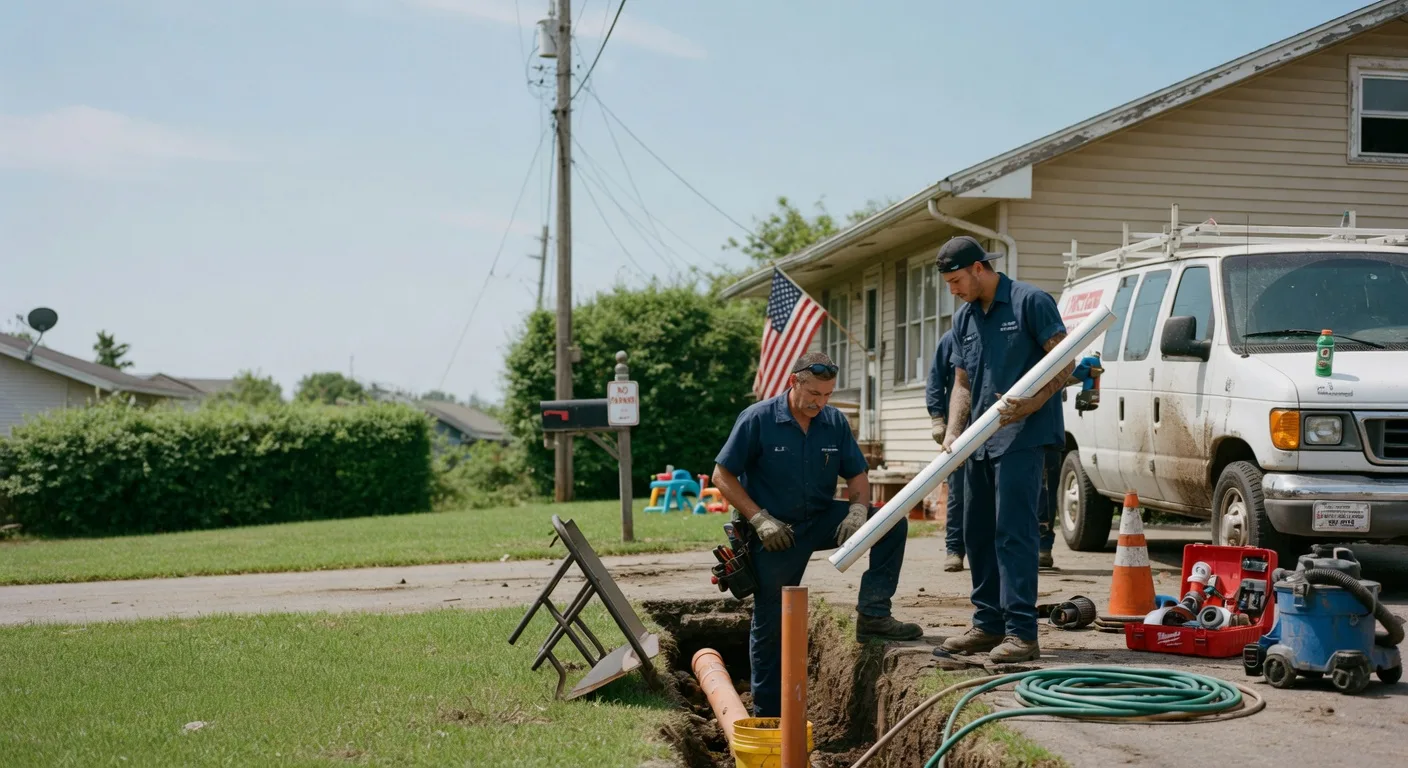
Can it be cleaned? Yes, up to a point. A cable machine can open a blockage sitting in the belly, and hydro jetting can wash grease and buildup off the pipe wall. Neither fixes the dip. The belly keeps holding water, so the buildup returns.
A camera inspection tells you the rest. It shows how deep the belly is, whether the pipe is cracked, and whether roots have entered a joint. Cost depends on how deep the line is, how much has to be dug up or removed, the materials involved and any permit.
Safe homeowner check: note whether one fixture or the whole house is slow. One fixture points to its own branch. Every drain slow points to the main line.
Stop running water and call now if sewage is coming up in a tub, shower or floor drain.
Expert Plumbers Co is a referral service. Call (380) 262-9173 and we will connect you with a plumber serving Palmyra, MO for Drain Cleaning or Emergency Drain Cleaning.
Left alone, a belly tends to get worse in a predictable way. The standing water softens the soil around the pipe further, the dip deepens, and the clogs come back faster each time. Another warning sign is a faint sewage smell in the yard or a patch of lawn that sinks or stays wet, which can mean the pipe has separated at a joint. Older homes with clay or cast iron lines are the most likely to have a belly, because those pipes sit in sections and shift as soil settles. Newer plastic lines can also sag when the trench bedding was uneven. When you speak to the plumber, ask what the camera shows about the depth of the dip and the condition of the pipe at that spot. If the pipe is intact, a spot repair may be possible. If it is cracked, replacing that section is the lasting fix.
My drains back up every autumn. Why is it seasonal?
That pattern is a clue. Drains that back up every autumn usually have a fixed fault that the season exposes.
Roots chase moisture and grow most actively in the warm months. A clay joint that was passable in spring can be choked by late summer. Then the first heavy autumn rain loads a line that was already marginal, and it backs up.
Leaves are the second cause. Leaves and seed debris wash into a yard drain, a window well or an open cleanout and pack the line. A third cause is a blocked vent stack. Leaves over the roof opening cause gurgling and slow flow without any clog in the pipe.
Safe homeowner check: clear the gutters and the yard drain grate, lift leaves out of the window well, and check that the cleanout cap is seated. Listen for gurgling after a toilet flush.
Stop running water and call now if every drain in the house is slow or backing up, if the lowest tub or floor drain bubbles or fills, or if sewage odor is strong. Those signs point to the main line or a failed sewer lateral. Water used in the house only adds to the backup. Emergency Drain Cleaning calls come from exactly this situation.
A single slow fixture is a cable job. A line that clogs on a schedule is a camera inspection case, because the interval is a symptom of a fixed fault. The camera shows whether it is root intrusion, a bellied section or a damaged joint. Hydro jetting clears the line, and the repair deals with the cause.
Expert Plumbers Co is a referral service. We refer homeowners in Palmyra, MO to an independent local plumber. Call (380) 262-9173.
Keep a simple log. Note the date, the weather and which fixtures backed up each time. If the dates cluster on rainy days, a storm load or root problem fits. If they follow leaf fall in dry weather, look first at the vent stack and the outside drains. Hand the log to the plumber. It saves a lot of guessing.
If you can plan ahead, book a camera inspection in late summer, when roots are at their thickest and the line is not under storm load. Cutting roots back then, before the rain, is a calmer job than an overnight backup.
Be wary of root-killing foam as a cure. It can slow regrowth, but it does not repair the joint where the roots get in, and they return. Shallow-rooted trees near the lateral, such as willows and maples, are repeat offenders, so mention what grows near the line. Learn where your cleanout is before you need it.
Water shows up around the base of the toilet after flushing. Is that the drain or the seal?
"There is water around the base of my toilet after I flush." Water at the floor can come from three places, and only one of them is the drain.
The most common cause is a failed seal. A toilet sits on a wax ring or a rubber seal that joins it to the flange, the fitting on the floor drain. If the ring is crushed or the toilet rocks, water escapes at the base during the flush. A loose bolt, a cracked flange or a flange set too low can do the same.
A drain problem is the other case. If the toilet is partly blocked, the flush water slows and rises, and it can push out at a weak seal. Grease build-up, a bellied line holding water, or root intrusion at a clay joint can all do this.
Here is the test. If only this toilet leaks and every other drain runs clean, think seal or flange. If the bowl drains slowly, gurgles, or the tub and floor drain are also slow, think drain. If every drain in the house is backing up, the main line or sewer lateral is involved.
Safe homeowner check: Flush and watch where the first drop appears. Press the toilet by hand to see if it rocks. Check the supply line and shutoff valve for drips. Look at the bowl: does it drain quickly or slowly? Do not over-tighten the closet bolts, because porcelain cracks.
Stop running water and call now if the water on the floor smells of sewage, the toilet will not drain or the bowl rises, other fixtures are backing up, or water is coming through a ceiling below.
A cable machine is enough for a toilet blocked by a clog close to the bowl. A seal or flange job is a reset, not a drain job: the toilet is lifted and a new ring and fittings go in. If the drain keeps slowing, a camera inspection can show roots or a belly, and hydro jetting is used for grease or scale coating the pipe wall.
Expert Plumbers Co is a referral service. We connect you with an independent local plumber in Palmyra, MO. Call (380) 262-9173.
Ask the plumber to say whether the problem was the seal, the flange or the drain, and what they checked. Ask if the subfloor is wet or soft, since that can widen the work. Cost depends on access, the parts or materials needed, how much has to be opened up or removed, and any permit or code requirement.
Our older house has a house trap, or running trap, in the basement. Why does it keep clogging?
Your basement drain backs up every so often, and each time someone points at the house trap and clears it again. In an older house that is a familiar story.
A house trap, also called a running trap, is a U-bend on the main drain near the foundation wall, with two cleanout plugs. It holds water to keep sewer air out. The trouble is that the dip slows the flow and gives solids a place to settle. Paper, grease, wipes and roots that pass through a straight pipe pile up in the bottom of the bend, so the trap becomes a frequent stoppage point.
Old lines make it worse. Scale in cast iron roughens the pipe and catches debris before it reaches the trap. Root intrusion at a clay joint outside sends fibres toward it. A bellied line downstream can hold water back so the trap never fully clears. Many traps were removed over the years, and local code on keeping or removing one varies.
One slow fixture is usually its own branch problem. If toilets, tubs, sinks and the washer all slow down together, or the floor drain bubbles, the trap or the main beyond it is the likely spot.
Safe homeowner check: Stop using water and look at the two trap plugs without opening them. Check whether the floor drain is holding water, and note which fixtures back up first.
Stop running water and call now if sewage is coming up from a floor drain or shower, if you smell sewage in the basement, or if a plug is weeping. Never loosen a trap plug under pressure, because sewage can surge out.
A cable machine is often enough to clear the trap itself when the stoppage is soft. Hydro jetting is the better choice when grease or scale lines the pipe on either side. A camera inspection is the right step when the trap keeps clogging, because it shows whether the real fault is a belly, a root-filled joint or a failing section further down.
Expert Plumbers Co is a referral service. We connect you with an independent local plumber in Palmyra, MO. Call (380) 262-9173.
Ask whether the trap can stay and be cleaned when needed, or be removed where code allows. The scope depends on basement access, the condition of the pipe on both sides, how much floor has to be opened up, and any permit or code requirement for changing the main.
Our walk-in shower has a long linear drain and it keeps backing up. Why?
Your walk-in shower has that long, slim linear drain along one wall or the back edge, and it keeps backing up. The water rises around your feet, drains slowly, then does it again a week later. There are a few reasons a linear drain behaves this way.
The channel is long and shallow, so it collects hair and soap scum along its whole length. Many linear drains also have a small outlet at one end or in the middle, often undersized compared to the flow from a large shower head. If the pan is built with a low slope toward the drain, water crawls instead of running, which leaves scum behind and lets hair settle. Under the cover, the trap or the first section of pipe can also fill with hair, so the channel looks clean and still backs up.
If only the shower backs up and the sink and toilet in the same bathroom are fine, the problem is the channel, its outlet, the trap or the shower branch. If other fixtures are slow or gurgling, or water shows in a floor drain, the line further down is involved.
Safe homeowner check: lift out the grate or cover and clean the channel with gloves. Look at how water moves across the floor, because standing water on the pan suggests a slope problem rather than a clog alone. Skip chemical openers.
Stop running water and call now if sewage or gray water comes up elsewhere, if you see moisture on the ceiling or walls below the shower, if the floor around the shower feels soft, or if a sewer smell comes with the backups. A leaking pan is a different problem from a clog and can damage the structure.
A cable machine is usually enough for hair and soap in the trap or short branch, though the plumber must be able to get past the channel outlet. If the problem keeps coming back, a camera inspection can show a belly, offset or roots beyond the shower. Hydro jetting may be proposed when the pipe wall is coated with grease or scale.
Expert Plumbers Co is a referral service. We connect you with an independent local plumber in Palmyra, MO. Call (380) 262-9173.
Ask the plumber whether the cause is the drain body, the slope of the pan or the pipe beyond it. If the slope or outlet is the problem, ask what it takes to correct it. The scope depends on access to the drain, the parts or materials needed, how much tile or floor has to be opened up, and any permit or code requirement.